

Review · USA
New Orleans True Crime and Coffee Walking Tour: Adults Only
New Orleans has plenty of ghost stories, but this adults-only walking tour keeps its attention on crimes with real names, places, and consequences. You’ll hear about executions at Jackson Square, a love story that turned tragic during Hurricane Katrina, the 1973 Upstairs Lounge fire, New Orleans piracy, and the city’s mafia.
I like the way the route uses actual French Quarter locations rather than treating crime as a collection of spooky tales. I also like the mid-tour stop for coffee, tea, or hot chocolate, which gives you a warm pause before the final stories. The main consideration is the subject matter: executions, arson, murder, and disaster are central to the experience, so this is not a light sightseeing walk.
Key points to know before booking
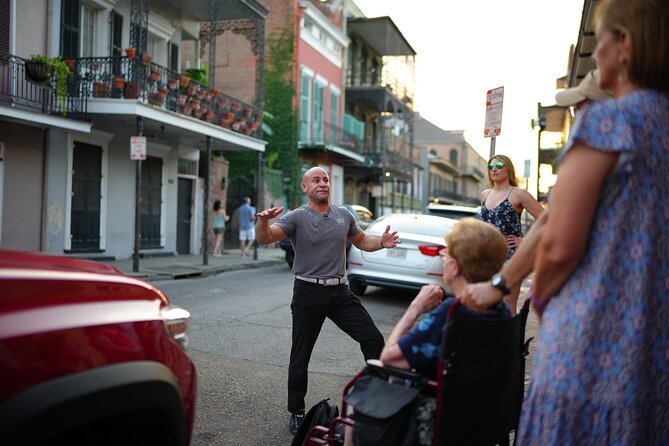
- The route covers six specific French Quarter stops, beginning at Jackson Square and ending at the Louisiana Supreme Court.
- Jamie may lead the tour, and the experience is designed around lively storytelling as well as historical facts.
- The Upstairs Lounge story is tied to the Jimani Lounge and Restaurant, giving the 1973 arson account a clear physical setting.
- A café stop is built into the route, with coffee, tea, or hot chocolate included as a planned break in the walk.
- The group can reach 28 people, large enough for energy but not an intimate private walk.
- The tour lasts about 1 hour and 45 minutes, starts at 10:00 a.m., and costs $39 per person.
Why this New Orleans crime walk works
This tour makes good use of a simple idea: New Orleans history becomes more immediate when you hear it at the place where events unfolded. Jackson Square, Royal Street, Exchange Place, and the French Quarter’s old buildings are not just scenery between stories. They give each account a physical anchor.
The experience also avoids the usual nighttime tour setup. You walk in daylight, with less concern about finding your way through dark streets or crowded evening entertainment areas. One person specifically praised seeing parts of the French Quarter during the day, when the streets were quieter and easier to take in.
The guide matters here. Jamie is singled out for keeping the group entertained while knowing the facts. That combination is important on a crime tour. Too much performance can make painful events feel cheap, while too much detail can turn the walk into a lecture. The best version of this experience should keep the stories clear, human, and tied to place.
At $39, the value depends on what you want from a tour. You are paying for nearly two hours of guided interpretation, six stops, and a hot drink break. It is not the cheapest way to walk through the French Quarter, but it gives you a focused subject and a route you might not create on your own. If you already know New Orleans crime history well, the price may feel less appealing. If you want a structured introduction with a guide doing the research and storytelling, it is reasonable.
More Walking Tours in the USA:
- Seattle: Coffee Culture Walking Tour
★ 4.8 · 84 reviews - Portland’s Best Chocolate and Coffee Walking Tour
★ 5.0 · 28 reviews - Savannah History plus Coffee and Chocolate Walking Tour
★ 5.0 · 28 reviews
Jackson Square begins with executions
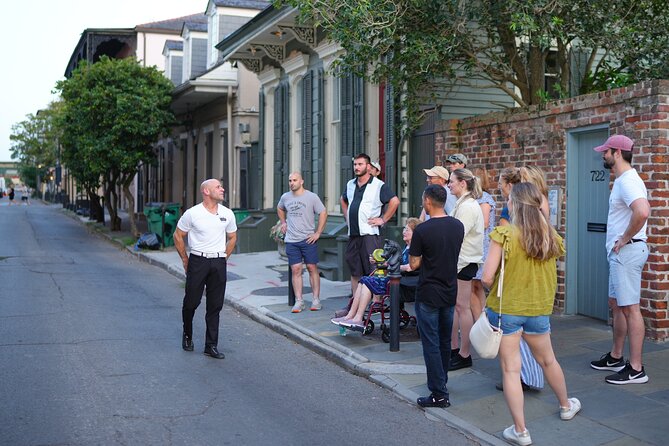
The tour starts at 700 Chartres Street, close to Jackson Square, at 10:00 a.m. The opening outline helps you understand the shape of the experience before the first story begins.
The first stop deals with executions. That is a blunt way to begin, but it sets the tone properly. This is not mainly a stroll through pretty streets with a few spooky details added for effect. The route looks at the darker side of New Orleans, including public punishment and the way crime has been handled and remembered.
Jackson Square is a useful starting point because it gives the group a recognizable center in the French Quarter. You receive a quick introduction, then spend about 15 minutes on the opening account. Admission to the square is free, but the value comes from the guide’s explanation rather than from entering a paid attraction.
I would arrive early. The operator cannot accommodate late arrivals, and the meeting point is in a part of town where traffic, rideshares, and pedestrian congestion can affect your timing. Plan your Uber, Lyft, taxi, or other transportation before the morning begins.
The Omni Royal Orleans and a Katrina-era tragedy
The second stop is at the Omni Royal Orleans, where the tour discusses a love story that went terribly wrong during Hurricane Katrina. The stop lasts about 15 minutes.
This is a different kind of crime story from the opening discussion. Instead of public executions or organized crime, the focus shifts to private relationships under extreme pressure. Linking the account to Hurricane Katrina also brings a major New Orleans event into the tour without reducing the disaster to weather or property damage.
The subject may be emotionally difficult. You are hearing about love, betrayal, and tragedy in the context of a storm that caused widespread suffering. The tour is adults-only, and that restriction makes sense given the themes.
The stop is also a reminder that true crime is not only about famous criminals. Some of the most unsettling stories involve ordinary human decisions made under pressure. If you prefer tours that explain how major events affected individual lives, this portion may be one of the more memorable sections.
The Jimani Lounge and the 1973 Upstairs Lounge fire
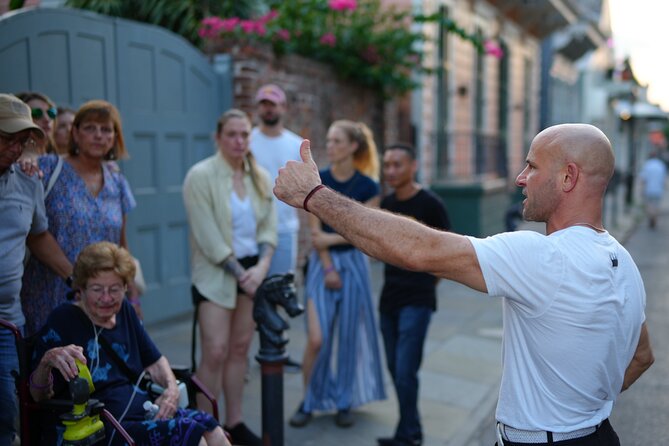
At the Jimani Lounge and Restaurant, the guide discusses the arson that took place in 1973, when the location was known as the Upstairs Lounge. The stop takes about 15 minutes.
This is likely the most historically weighty stop on the route. The story concerns a deliberate fire and the people affected by it, not a ghostly rumor or a colorful outlaw tale. Hearing it at the building connected to the event gives the subject a direct link to the city around you.
The location also shows how New Orleans places can carry several identities over time. A present-day restaurant or bar may occupy a site with a painful past that is easy to miss if you simply walk by. That is one of the strongest reasons to take a guided route instead of relying only on a general French Quarter history walk.
The story should be approached with care. Arson and loss of life are not entertainment in the ordinary sense, and some people may find this stop upsetting. The guide’s tone matters greatly. Jamie’s ability to keep people engaged while handling factual material is a useful sign, but you should still book only if you are comfortable with serious subject matter.
A few more coffee tours around the USA worth a look
- Big Island Highlights: Coffee, Volcano, Black Sands & Waterfall
★ 5.0 · 1,054 reviews - Seattle Coffee Tour: Capitol Hill Cafes, Tastings & Local Stories
★ 5.0 · 489 reviews - Award Winning Farm Tour: Coffee, Chocolate and Unique Gifts
★ 5.0 · 484 reviews - Big Island: Volcanoes, Waterfalls, & Coffee Farm Day-Trip
★ 4.9 · 414 reviews
A warm drink and New Orleans pirate lore
The route then moves to the Jean Lafitte Trading Company for coffee, tea, or hot chocolate. The stop lasts about 20 minutes, making it the longest planned pause.
I like this break for practical reasons. A walking tour can feel rushed when every stop is another standing lecture. A warm drink gives you time to reset, especially if the morning is cool or damp. It also changes the rhythm of the tour before the next set of stories.
The stop introduces the history of Jean Lafitte, described here as the most infamous pirate to live in New Orleans. Lafitte is a natural fit for this city. His story connects the French Quarter to smuggling, piracy, and the blurred line between outlaw and local legend.
The coffee stop does not mean you should expect a full breakfast. The supplied information confirms a cup of coffee, tea, or hot chocolate, but not a meal or a particular food selection. If you need breakfast, eat before the tour or make separate plans.
This section may appeal to people who want more than modern crime. The pirate story adds an older layer to the route and gives the tour some tonal variety. After the serious Upstairs Lounge account, the change of subject can make the experience easier to absorb.
Exchange Place traces the mafia’s evolution
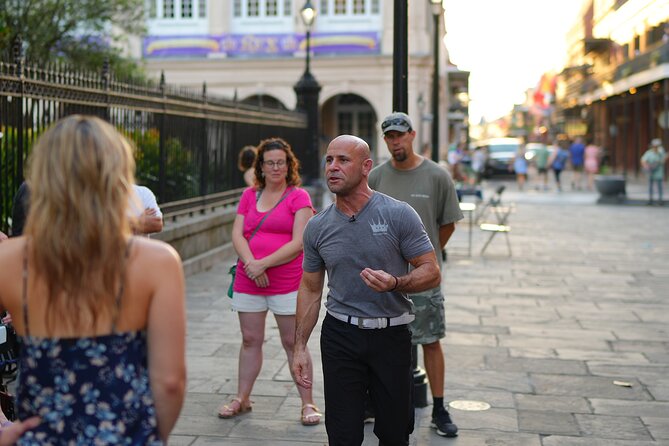
At Exchange Place, the guide discusses the evolution of the mafia in New Orleans. This is the shortest stop, at about 10 minutes.
Because the subject is broad, the time limit is worth noting. You should expect a concise account rather than an exhaustive history of organized crime. The value is in understanding how criminal networks changed over time and how New Orleans fit into that story.
Exchange Place helps keep the discussion tied to the city itself. Instead of treating the mafia as a distant national subject, the tour places it within the streets you are walking. That approach can make a familiar crime topic feel more specific.
This stop is also where your expectations matter. If you are looking for a detailed study of every major figure, case, and organization, a 10-minute segment will not be enough. If you want a clear overview as part of a larger French Quarter walk, it provides a useful bridge to the final stop.
The Louisiana Supreme Court closes with power
The tour ends on the steps of the Louisiana Supreme Court building at 400 Royal Street. The final story concerns one of the most powerful and feared men ever to live.
The stop lasts about 15 minutes, giving the tour a strong closing note. After executions, personal tragedy, arson, piracy, and mafia history, the final account focuses on a figure whose influence reached far beyond ordinary street crime.
The ending point is convenient. It is only about two blocks from the starting area, so you remain in the French Quarter and can continue sightseeing, find lunch, or return to your accommodation without arranging another ride. The Supreme Court building also gives the final story a fitting setting, linking crime, authority, law, and power.
The tour does not provide entry into the court building. You finish on its steps. That is useful to know if you were expecting an interior visit or a formal courthouse tour.
Timing, group size, and the walking effort
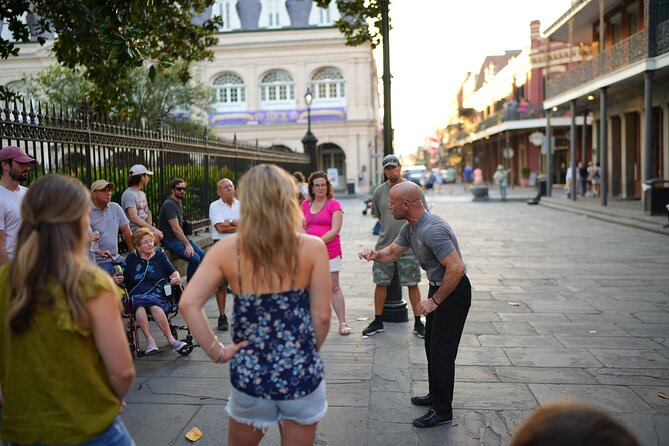
The total duration is about 1 hour and 45 minutes. The listed stop times add up to 90 minutes, with the remaining time used for walking, transitions, the coffee stop, and the opening and closing portions.
The group can include up to 28 people. That is not a private or highly personal format, but it is still a manageable size for a walking tour if the guide projects well. A larger group can make questions harder to ask and may require you to stay close to the guide, especially near busy streets.
The route is described as a walking experience through the French Quarter. The information does not provide a distance, step count, or specific accessibility details, so you should be prepared to walk and stand for much of the session. Most people can participate, and service animals are allowed.
Good weather is required. If poor weather causes cancellation, you receive the choice of another date or a full refund. The tour also needs a minimum number of people to operate, so a cancellation is possible if that threshold is not reached.
Who will get the most from this tour
This walk suits you if you enjoy:
- True crime presented at real locations
- New Orleans history beyond architecture, food, and music
- Short stories with a guide rather than a museum-style presentation
- Daytime sightseeing without the feel of a late-night ghost tour
- Serious subjects mixed with pirate and mafia history
- A compact activity that leaves most of the day free
It may not suit you if you want a cheerful general introduction to New Orleans, a family activity, or a tour focused mainly on haunted buildings. The adults-only rule is clear, and the content includes executions, a tragic relationship, arson, and feared criminal figures.
I would also think carefully if personal loss, disaster, or violent crime is a difficult subject for you. The tour does not hide behind vague folklore. Its appeal comes partly from dealing with unsettling events directly.
Practical booking advice and cancellation terms
The tour costs $39 per person and is offered in English with a mobile ticket. It is commonly booked well ahead of time, with an average booking lead of 21 days, so I would not assume you can wait until the morning of your preferred date during a busy New Orleans trip.
Free cancellation is available up to 24 hours before the 10:00 a.m. start time for a full refund. Changes or cancellations inside that 24-hour window are not accepted for a refund. The local time cutoff matters, so check your plans carefully if you are making changes from another time zone.
Since late arrivals cannot be accommodated, build in extra time for transportation. The route begins at 700 Chartres Street and finishes at the Louisiana Supreme Court, two blocks from the start. That short return distance makes it easy to pair the tour with other French Quarter plans.
Should you book the New Orleans True Crime and Coffee Walking Tour?
Book it if you want a focused, adults-only look at the city’s darker past and like hearing stories at the places connected to them. The mix of executions, Katrina, the Upstairs Lounge fire, Jean Lafitte, organized crime, and a powerful final figure gives the 1-hour-45-minute route more variety than a single-theme ghost walk.
The strongest reasons to choose it are the real French Quarter settings, the daytime schedule, the planned hot drink break, and the guide-led storytelling associated with Jamie. The main limits are the serious content, the group size of up to 28, the weather requirement, and the fact that each major subject receives only a short treatment.
At $39, I see it as a fair choice for a first visit or for anyone who wants a compact history activity with a clear point of view. Skip it if you want a broad introduction to New Orleans or prefer to avoid violent and distressing stories.
FAQ
Where does the tour begin?
It begins at 700 Chartres Street in New Orleans, near Jackson Square.
What time does the tour start?
The tour starts at 10:00 a.m.
Where does the tour end?
It ends on the steps of the Louisiana Supreme Court building at 400 Royal Street.
How long does the experience last?
The tour lasts approximately 1 hour and 45 minutes.
How much does the tour cost?
The price is $39 per person.
Is the tour offered in English?
Yes. The experience is offered in English.
Is this tour suitable for children?
No. It is advertised as adults-only.
Is a drink included during the tour?
The route includes a stop for coffee, tea, or hot chocolate at the Jean Lafitte Trading Company.
What happens if the weather is bad?
If poor weather causes cancellation, you are offered another date or a full refund.
Can I cancel for a full refund?
Yes. You can cancel at least 24 hours before the start time for a full refund. Cancellations made less than 24 hours before the start time are not refunded.
Just added around the USA
- Roasted in Seattle Bean to Cup Coffee Tour★ 5.0 · 5 reviews
- Roasted in Seattle: Bean to Cup Coffee Tour★ 5.0 · 15 reviews
- Roast Your Own Coffee★ 5.0 · 2 reviews
- Coffee Roasters of Portland Eastside Walking Tour★ 5.0 · 7 reviews
- Kona Coffee Tasting: A Farm to Cup Experience★ 5.0 · 5 reviews
- Historic Grounds: A Music City History and Coffee Morning Tour★ 5.0 · 19 reviews
- Turkish Coffee Fortune Reading★ 5.0 · 15 reviews
- The Little Havana Walking Tour: A Taste of Cuba in Miami★ 4.5 · 2 reviews
Walking Tours, compared.

Hungry in Vienna? A Food Lover’s Coffee & Market Walk
Read our review →
Private Walking Tour, Food Tasting and Bosnian Coffee in Sarajevo
Read our review →
Hanoi Michelin Star Walking Food Tour & Train Street
Read our review →
Vienna Eats: Private Foodie Walk with Coffee & Markets
Read our review →
Angra do Heroísmo: Walking Tour with Local Pastry and Coffee
Read our review →
Kilimanjaro: Village Walk, Coffee Tour, Waterfall, and Lunch
Read our review →Browse the lists this tour appears in