
Review · SARAJEVO
Private Walking Tour, Food Tasting and Bosnian Coffee in Sarajevo
Sarajevo’s story is packed into a short walk: Ottoman bazaars, Austro-Hungarian buildings, places of worship, and the bridge linked to the start of World War I. This tour adds food to the history, so you do not just look at old Sarajevo, you taste part of it.
I like the private format, which lets you ask questions and move at your own pace with only your group. I also like the coffee lesson and tasting at Morica Han, where Bosnian coffee becomes a custom to understand, not just another drink.
The main consideration is timing. Two and a half hours is enough for an excellent introduction, but stops are brief, and the food portion depends on what is served that day. If you want long museum visits or a slow lunch, you may need to explore further afterward.
Key points to know before you book
- A private walk through Sarajevo’s historic center: Only your group takes part, with an English-speaking guide.
- Traditional food is part of the experience: You stop near Bravadziluk Street, Sarajevo’s main area for Bosnian restaurants and sweets.
- Bosnian coffee is explained and tasted: The tour shows you how coffee is prepared and consumed in local tradition.
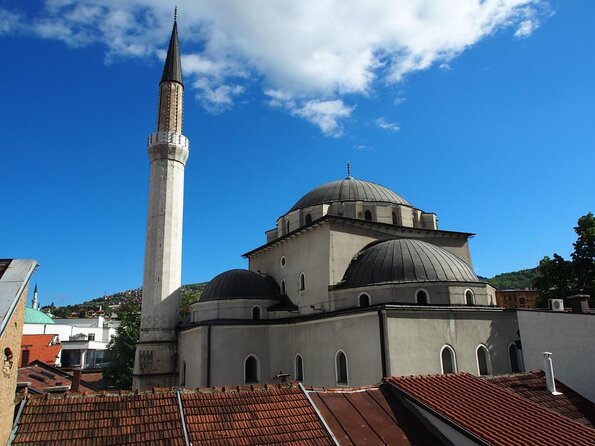
- Three faith traditions appear close together: The route includes the Sacred Heart Cathedral, Gazi Husrev-beg Mosque, and Serbian Orthodox Cathedral.
- The route connects major turning points: You see Sarajevo City Hall, the Latin Bridge, and the place linked to Franz Ferdinand’s assassination.
- Good value for a first visit: At $66.54 per person, the fee covers a private guide, food tasting, coffee, and a focused city introduction.
Sarajevo in one walk, from Ottoman bazaar to world history
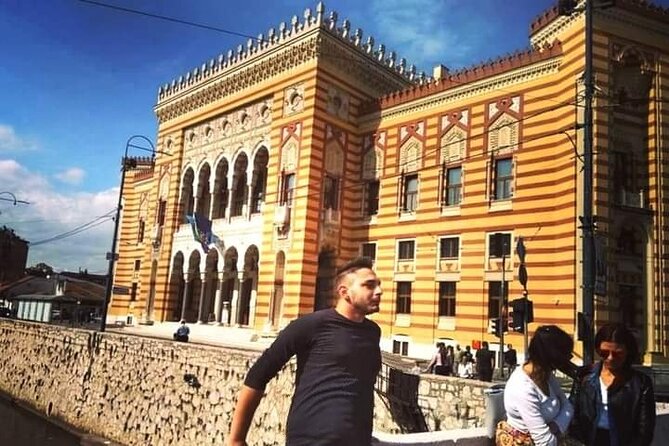
The tour starts at Sarajevo City Hall on Brodac, beside the Miljacka River. That is a useful meeting point because the building is easy to identify and places you close to the old quarter from the start.
You will walk through central Sarajevo rather than ride between scattered sights. That matters here. The city’s story is best understood on foot, where a narrow market street can give way to a grand Austro-Hungarian façade within a few minutes.
The route is not simply a march from one monument to the next. Your guide connects daily life with major events: coffee customs, copperwork, religious architecture, the Ottoman period, the Austro-Hungarian era, and the political crisis that led to World War I.
Because this is a private activity, you can ask for more detail when a subject catches your attention. Guides named Emina and Lamija have led this experience, and the feedback about both points to warm, personal guiding. Guide assignments can vary, so you should not book on the assumption that one specific person will lead your walk.
More Coffee Tastings in the world:
- Hanoi Coffee Experience: 6 Brews, 9 Recipes & 3 Liquor Tastings
★ 5.0 · 2,945 reviews - 4×4 Dominican Adventure with Chocolate and Coffee Tasting
★ 5.0 · 2,920 reviews - 4×4 ATV Experience, Water Cave, Chocolate and Coffee Tasting
★ 5.0 · 1,430 reviews
Sebilj and Pigeon Square: Sarajevo’s lively starting point
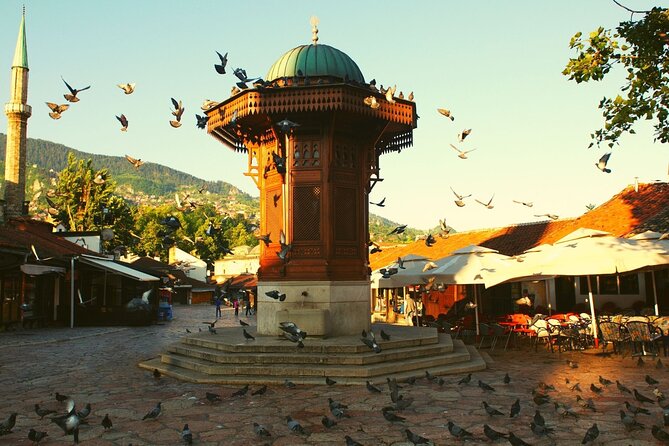
The first main stop is Sebilj, the wooden fountain at Baščaršija’s Pigeon Square. This 18th-century fountain is one of Sarajevo’s most recognizable sights, and it gives the tour a clear visual introduction to the old bazaar.
You spend about 25 minutes here, which is the longest scheduled stop. That leaves time for your guide to explain the fountain, the square, and Sarajevo’s wider past before you move into the lanes of Baščaršija.
This is a good opening because the square is not an isolated monument. It is part of the old commercial center, surrounded by streets, shops, and historic buildings. You get your bearings quickly, then begin to see how Ottoman planning still shapes the center.
The drawback is that Pigeon Square can feel busy, especially around the fountain. If you want quiet photographs, use the time when the guide is speaking to look for a less crowded angle rather than expecting a peaceful courtyard.
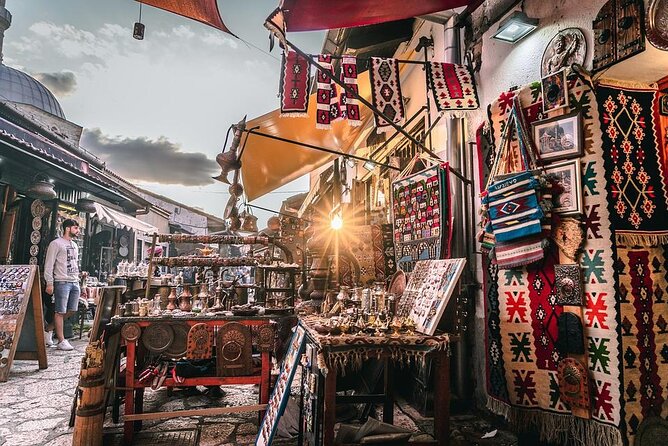
Copperwork on Kazandžiluk Street
Kazandžiluk is Sarajevo’s old coppercraft street. Its name is tied to the craft of making copper goods, and the shops offer a close look at an old trade that remains part of the city’s identity.
The stop lasts about 10 minutes, so think of it as an introduction rather than a full shopping visit. You may see decorative copper and brass pieces, along with practical advice from your guide about the role of coffee equipment in Bosnian homes and social life.
One especially striking detail mentioned during the experience is the transformation of mortar shell casings into vases. That kind of craft carries a difficult history, but the finished objects give it a useful, peaceful purpose. If you are considering a purchase, this is the point to ask about local metalwork and how to distinguish a handmade item from a mass-produced souvenir.
You will not have unlimited time to browse. The tour is built around the story of the street, not an extended shopping session, so return later if you want to compare pieces or buy gifts.
Morica Han and the Bosnian coffee lesson
Morica Han is one of the tour’s best stops. This former caravanserai recalls the Ottoman period, when merchants and their animals needed places to rest during long journeys. The courtyard setting helps you picture Sarajevo as a trading center rather than only a modern capital.
Here, your guide explains how Bosnian coffee is prepared and how locals drink it. You also taste it in the traditional manner. The point is not simply caffeine. Coffee comes with its own equipment, serving habits, and social rules, and this stop gives those customs a place in the city’s past and present.
You should pay attention to the distinction between Bosnian coffee and the way coffee may be served elsewhere in the Balkans. Your guide can explain the local practice directly, which is more useful than trying to learn it from a menu.
For many people, this is the most memorable part of the tour because it is participatory. You are not just looking at architecture. You are learning a small daily ritual and can take the habit home. One useful tip is to ask your guide to repeat the serving instructions if you want to recreate the experience later.
More Food and Drink Tours in the world:
- Early Morning My Son Sanctuary Trip w. Champa Food & Coffee
★ 5.0 · 629 reviews - Buggy Ride Into the jungle with cave coffee & chocolate tasting
★ 5.0 · 465 reviews - Hamburg: Speicherstadt Walking Tour with Coffee Tasting
★ 4.6 · 360 reviews - Road Off Half Day Buggy with Chocolate and Coffee Tasting
★ 5.0 · 326 reviews
Bravadžiluk Street and the taste of Sarajevo
Bravadžiluk Street is known for restaurants serving Bosnian food and sweets. The food portion of the tour is not presented as a formal cooking class. Instead, your guide recommends dishes and takes you to a local café or food stop for a tasting.
The menu is not specified in advance, so do not book expecting a named set of dishes. What you can expect is a chance to sample traditional food and learn which meals and sweets are especially popular in Bosnia. The tasting has been described as generous, so this may function as a light meal rather than a tiny sample.
This is where a private guide adds real value. You can explain what you like, ask about ingredients, and get suggestions for another meal later in your stay. If you have allergies, dietary restrictions, or strong dislikes, tell the operator before booking or contact them ahead of time. The supplied details do not promise a special dietary menu.
The food stop is short in the written schedule, only a few minutes for Bravadžiluk itself, while the broader tasting experience takes longer. The timing may feel quick if you want to sit over lunch, but it keeps the tour moving through the old center.
The old clock tower and Sarajevo’s unusual time
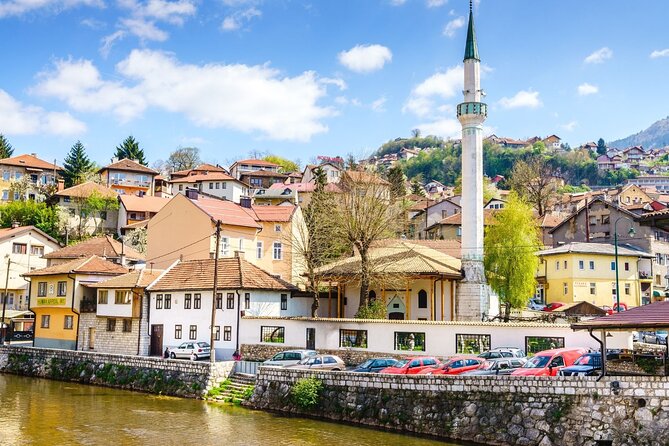
Near Gazi Husrev-beg Mosque, you see Sarajevo’s old clock tower. It is known for showing a special type of time tied to the setting of the sun, a reminder of the city’s Ottoman past and religious customs.
The scheduled stop is only about two minutes, so this is a quick explanation rather than a full visit. Still, it is the sort of small detail that makes a walking tour worthwhile. You might pass the tower alone and see only an old clock. With context, you understand why its display is unusual.
Do not expect time to climb the tower or study it at length. The value comes from the story, then from seeing how close it is to the mosque and bazaar.
Sarajevo’s places of worship, close together
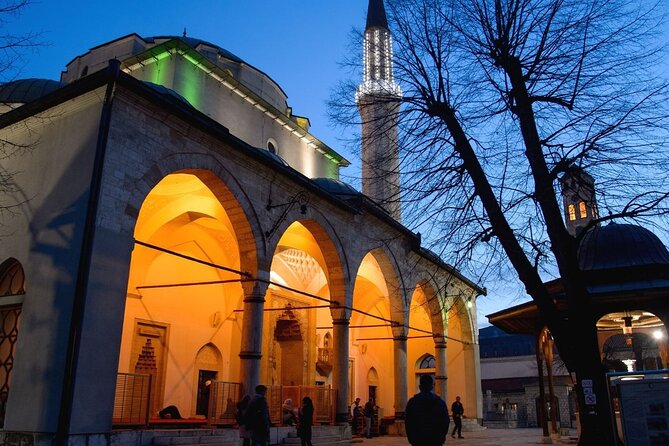
The route then shifts from market life to religious architecture. You visit the Sacred Heart Cathedral, Gazi Husrev-beg Mosque, and the Serbian Orthodox Cathedral of the Nativity of the Theotokos.
At the cathedral, the guide discusses its Neo-Renaissance design and its construction during Austro-Hungarian rule. You also see the statue of Pope John Paul II, who visited Bosnia twice, and learn about Sarajevo roses, memorial marks connected with the city’s wartime suffering.
Gazi Husrev-beg Mosque is one of Sarajevo’s largest and most important mosques. Its presence near the old bazaar shows how closely religious life and trade were linked in the Ottoman city. The visit is a chance to discuss both architecture and the place of Islam in Sarajevo’s identity.
The Serbian Orthodox Cathedral adds another architectural and religious layer. It is the city’s largest Orthodox church and is known for its design and construction story. Seen together, these stops give you a more useful picture of Sarajevo than a single monument could.
The tour does not promise interior access to every religious building. Dress and entry conditions can vary, and the schedule gives each sight limited time. I would treat these stops as guided introductions rather than full worship-site visits. Follow your guide’s instructions, particularly at the mosque.
Sarajevo City Hall and the Austro-Hungarian chapter
Although the walk begins at City Hall, the building deserves attention as more than a meeting point. Sarajevo City Hall is often considered the finest representative of the Austro-Hungarian period in the city.
It also served as the National and University Library. That detail makes the building’s wartime story especially painful, since libraries represent a city’s memory and learning as much as its government.
The scheduled look at the building lasts about 10 minutes. You may not have time for an extended interior visit, and admission to the tour stops is listed as free rather than as a separate paid entry. If you want to explore the building in detail, check whether you need a separate ticket or visit time.
For a first walk through Sarajevo, City Hall is an effective starting point. It shows how quickly the city’s style changes from Ottoman lanes to grand European public buildings.
Latin Bridge and the event that changed the century
The walk ends near Latin Bridge, the place associated with the assassination of Archduke Franz Ferdinand. That event helped set off the chain of decisions that led to World War I.
The bridge itself is modest. The importance comes from the setting and the explanation. Your guide can help you understand why this particular spot became part of world history, rather than leaving you with only a plaque and a famous name.
The final stop lasts about 10 minutes. Ending here is practical because you are left in the central area, close to other sights, restaurants, and walking routes. The activity ends at a different location from the start, so plan to continue sightseeing from Latin Bridge rather than returning to City Hall.
What $66.54 buys you
At $66.54 per person, this is not the cheapest way to walk through Sarajevo. It is also not just a sightseeing walk. The fee includes a private English-speaking guide, food tasting, and Bosnian coffee, as well as interpretation at several major landmarks.
The value improves if you are traveling with friends or family and can share the private experience as a group. You get the attention of one guide instead of joining a large party, and you can ask questions without waiting for a whole crowd.
The price is harder to justify if you only want to photograph the main sights and do not care about food or local customs. You could walk through Baščaršija independently. The paid value lies in the connections: why the clock shows an unusual time, how the coffee is served, what to order on Bravadžiluk Street, and how Ottoman, Austro-Hungarian, and religious landmarks fit together.
The activity is often booked about 28 days ahead, so reserve early if your schedule is fixed. Confirmation arrives at booking, and free cancellation is available until 24 hours before the start time. A cancellation inside that period is not refundable, and the operator may offer another date or a full refund if the minimum number needed to run the activity is not reached.
Who will get the most from this walk
I would choose this tour for a first day in Sarajevo. It gives you the basic map, introduces the old center, and provides food advice you can use during the rest of your stay.
It also suits you if you want history without spending hours in a museum. The route covers major events and buildings through short explanations, with coffee and food to break up the architecture.
The private format works well for families, couples, and small groups with different interests. One person can ask about Ottoman buildings while another asks where to eat. Most people can participate, and service animals are allowed.
I would be more cautious if you need a fully accessible route, since the supplied information confirms that most people can participate but does not describe every surface, step, or restroom. Ask the provider for current route details before booking if mobility is a concern.
Should you book this Sarajevo food tour?
Book it if you want a compact, personal introduction to Sarajevo that combines landmarks with something you can taste and practice. The strongest parts are the Bosnian coffee lesson, the food stop on Bravadžiluk Street, the coppercraft discussion, and the close look at the city’s different religious and imperial layers.
Skip it if you prefer to explore slowly on your own, spend substantial time inside monuments, or choose every dish independently. The schedule is brisk, and several stops last only a few minutes.
For most first-time visitors, I think the $66.54 price is fair because you receive more than directions and dates. You get a private guide, a useful first orientation, traditional food, and a coffee custom that helps Sarajevo feel like a place to understand rather than merely a place to photograph.
FAQ
Where does the tour start?
It starts at Sarajevo City Hall, Brodac 1, Sarajevo 71000, Bosnia and Herzegovina.
Where does the tour finish?
The activity ends at a different location from the meeting point, near Latin Bridge.
How long does the experience last?
The tour lasts approximately two hours and 30 minutes.
Is this a private tour?
Yes. Only your group participates in the activity.
Is the tour offered in English?
Yes. English is the stated language for the experience.
What is included in the food portion?
You receive traditional food tasting and recommendations for Bosnian dishes and sweets in the Bravadžiluk Street area. The exact dishes are not specified.
Do you taste Bosnian coffee?
Yes. The guide explains how traditional Bosnian coffee is prepared and consumed, and you taste it at Morica Han.
Are admission tickets included?
The listed stops have no separate admission ticket charge. The experience is primarily a guided walk through the historic center.
What is the cancellation policy?
You can cancel up to 24 hours before the start time for a full refund. Cancellations or changes made less than 24 hours before the start time are not accepted for a refund.
More Walking Tours in the world
- Dresden: Guided City Walk with a Cup of Coffee
★ 4.7 · 1,568 reviews - Seattle: Coffee Culture Walking Tour
★ 4.8 · 84 reviews - Vienna Eats: Private Foodie Walk with Coffee & Markets
★ 5.0 · 77 reviews - Angra do Heroísmo: Walking Tour with Local Pastry and Coffee
★ 4.8 · 65 reviews
More Food Tours in the world
- Hanoi: Vietnamese Street Food Tour with Egg Coffee
★ 4.9 · 315 reviews - Hungry in Vienna? A Food Lover’s Coffee & Market Walk
★ 4.9 · 276 reviews - Vienna: Typical Austrian Food Tour with Coffee House Visit
★ 4.8 · 159 reviews - Rome Pantheon: Award Winning Gelato Tiramisu & Espresso Food Tour
★ 5.0 · 99 reviews
Just added around the world
- Yerevan: Private Coffee Tour with 2 Café Stops★ 5.0 · 2 reviews
- Vietnamese Coffee 101 Workshop★ 5.0 · 11 reviews
- Vietnamese Coffee Making Class in Hoi An★ 5.0 · 4 reviews
- Vietnamese cooking class and coffee making with local girl★ 5.0 · 5 reviews
- Venice Delights: Coffee & Food Experience Walking Tour★ 5.0 · 2 reviews
- Private Vienna Tour: Literature Walk with Coffee House Visit★ 5.0 · 2 reviews
- Turin: Art Nouveau Walking Tour with Coffee★ 5.0 · 11 reviews
- Turkish Coffee and Traditional Turkish Dessert Cooking★ 4.6 · 8 reviews
Coffee Tastings, compared.
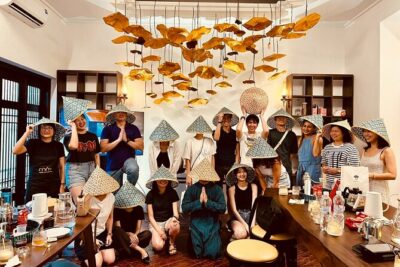
Hanoi Coffee Experience: 6 Brews, 9 Recipes & 3 Liquor Tastings
Read our review →
Coffee Tour with Transport, Snacks and Tastings
Read our review →
Seattle Coffee Tour: Capitol Hill Cafes, Tastings & Local Stories
Read our review →
Buggy Ride Into the jungle with cave coffee & chocolate tasting
Read our review →
Da Nang Cooking Class with Coffee Tasting and Market Visit
Read our review →
Poás Volcano and Coffee Tour with Tasting and La Paz Falls
Read our review →
Browse the lists this tour appears in