
Review · GERMANY
Dresden: Guided City Walk with a Cup of Coffee
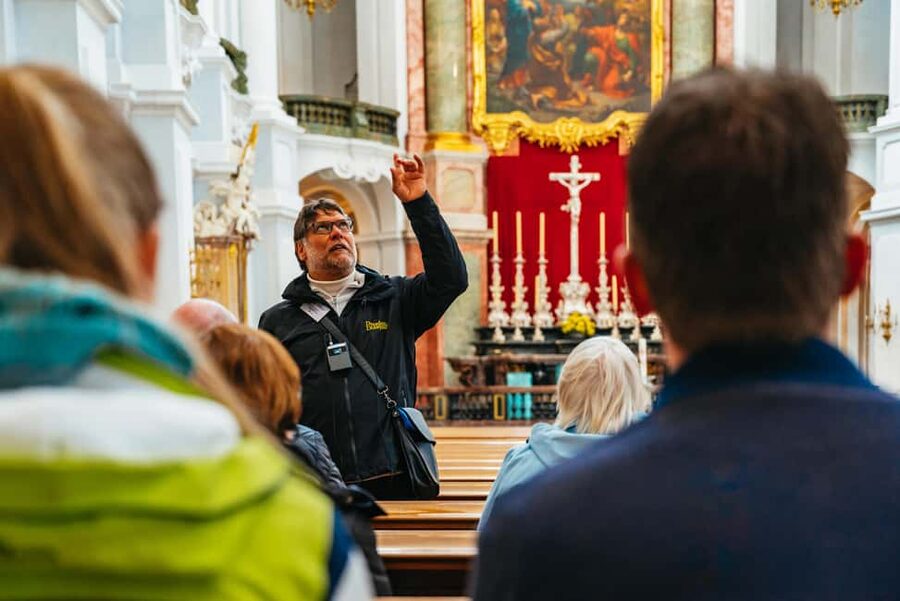
Dresden’s old town is a grand open-air lesson in power, faith, war, art, and rebuilding. In 90 minutes, this German-language walk links the Frauenkirche, Semperoper, Zwinger, Dresden Castle, and the riverside Brühl’s Terrace, while adding the stories that make the stonework matter.
I like the clear route through Dresden’s main sights and the guide’s mix of dates, anecdotes, and everyday history. The digital audio system is another practical plus, especially in busy squares. The main catch is simple: this tour is offered in German only, and one guest had to ask about the promised coffee coupon.
Key points to know
- The tour covers Dresden’s essential old-town sights: Frauenkirche, Semperoper, Zwinger, Residenzschloss, Fürstenzug, Stallhof, and Brühl’s Terrace.
- The 90-minute route is compact but full: You move on foot from Neumarkt through the historic center and finish near the Frauenkirche.
- The storytelling spans several eras: Expect the Middle Ages, Renaissance, Baroque Dresden, the destruction of war, and the Peaceful Revolution of 1989.
- The tour is in German only: A live guide leads the walk, supported by a digital audio system.
- You get practical local advice: Your guide can suggest restaurants and leisure activities for the rest of your stay.
- The price is modest: At $15 per person, it offers a useful introduction before you decide which interiors or museums deserve more time.
Dresden in 90 minutes: a smart first look
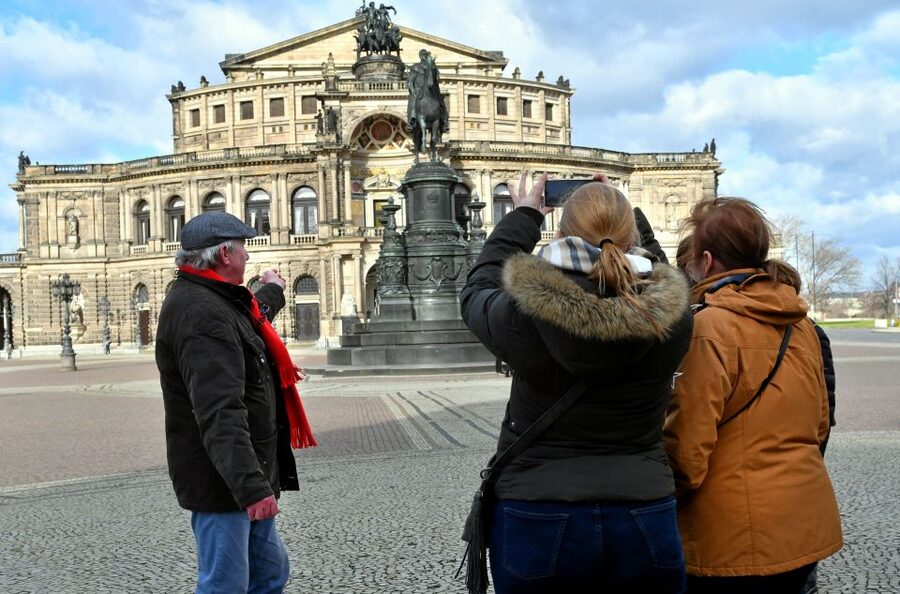
This walk is built for the first day of a Dresden visit. You see the city’s famous architectural set without spending half a day indoors or trying to decode a map on your own. The route also gives you enough historical footing to understand why Dresden’s center looks both old and newly rebuilt.
The city’s story is not a neat parade of pretty facades. Medieval settlement, royal ambition, Baroque display, wartime destruction, East German rule, reunification, and modern rebuilding all show up within a few blocks. A good guide helps you see those layers instead of treating each building as an isolated photo stop.
At $15, the value is strongest if you want orientation and context. You are not paying for museum admission or a long specialist lecture. You are paying for a local route, live explanation, a listening system, and a coffee coupon. If you already know Dresden well, the short format may feel basic. If it is your first visit, it is an efficient way to get your bearings.
The tour has a 4.7 out of 5 rating from 1,568 ratings, and the most consistent praise focuses on the guide’s informative style, clear explanations, and pleasant balance of facts and anecdotes. That mix matters. A list of construction dates is easy to forget. A story about how people experienced a city’s changes gives the buildings a human scale.
Starting at Neumarkt and Dresden Information
Meet your guide in front of Dresden Information, located in the basement of the QF Passage. This is a useful central meeting point, but allow a few extra minutes to find the entrance and go downstairs. The walk begins in the Neumarkt area, beside one of Dresden’s most recognizable landmarks, the Frauenkirche.
Neumarkt gives the guide an ideal opening scene. The square presents Dresden’s Baroque face, but it also raises questions about rebuilding and modern design. You will see how today’s city combines reconstructed historic forms with newer, sometimes debated buildings.
Because the tour ends near the Frauenkirche, the opening and closing areas connect neatly. You are not dropped at an unrelated corner of town. Afterward, you can continue sightseeing around Neumarkt, stop for the included coffee, or use the guide’s restaurant and leisure suggestions.
More Walking Tours in the world:
- Hamburg: Speicherstadt Walking Tour with Coffee Tasting
★ 4.6 · 360 reviews - Hungry in Vienna? A Food Lover’s Coffee & Market Walk
★ 4.9 · 276 reviews - Private Walking Tour, Food Tasting and Bosnian Coffee in Sarajevo
★ 5.0 · 255 reviews
Stallhof and Fürstenzug: royal life in public view
The route moves on foot to the Stallhof, the former royal stable yard. This courtyard helps explain how the Saxon court functioned. It is less instantly famous than the Frauenkirche or Zwinger, but it gives the walk a useful change of scale. Instead of looking only at grand church fronts and palace facades, you get a sense of the working spaces behind court life.
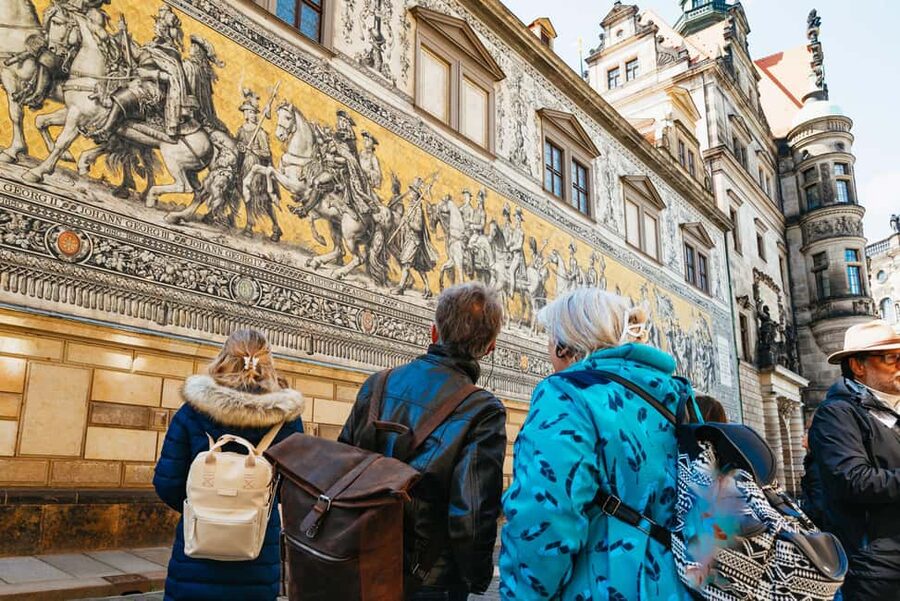
From there, the guide takes you to the Fürstenzug, or Procession of Princes. This long mural is one of Dresden’s most distinctive outdoor artworks. It presents a line of Saxon rulers and connects political history with a highly visible city landmark.
The Fürstenzug is especially helpful for understanding continuity. The mural is not just decoration on a wall. It presents a claim about Saxon power, succession, and identity. Your guide can also place it within the wider story of Dresden’s royal development, which is much easier to grasp when you are standing directly beside the artwork.
These stops are good examples of why a guided walk beats a quick checklist. You can photograph the mural on your own, but without context it is easy to miss what the figures represent and why the work occupies such a prominent place.
Brühl’s Terrace and the Elbe setting
Next comes Brühl’s Terrace, the broad riverside promenade often associated with Dresden’s elegant nickname, the Balcony of Europe. The terrace offers a different view of the city from the tightly packed old-town courtyards.
Here, you can pause from the details of facades and look at Dresden as a planned royal center beside the Elbe. The guide uses the setting to explain the city’s growth and the changing role of its buildings. This is also a good point for photos, though the tour’s pace means you should not expect a long independent stop.
Brühl’s Terrace can feel grand and calm, but the larger story is not only decorative. The walk connects Dresden’s royal image with the political and social changes that came later. The guide discusses the darker periods of the Middle Ages, the energy of the Renaissance, and the excess of the Baroque era before moving toward more recent German history.
If you prefer long photo breaks, this section may feel brief. The benefit is that you keep moving and still cover several major sights within the 90-minute limit.
Semperoper: Dresden’s grand stage
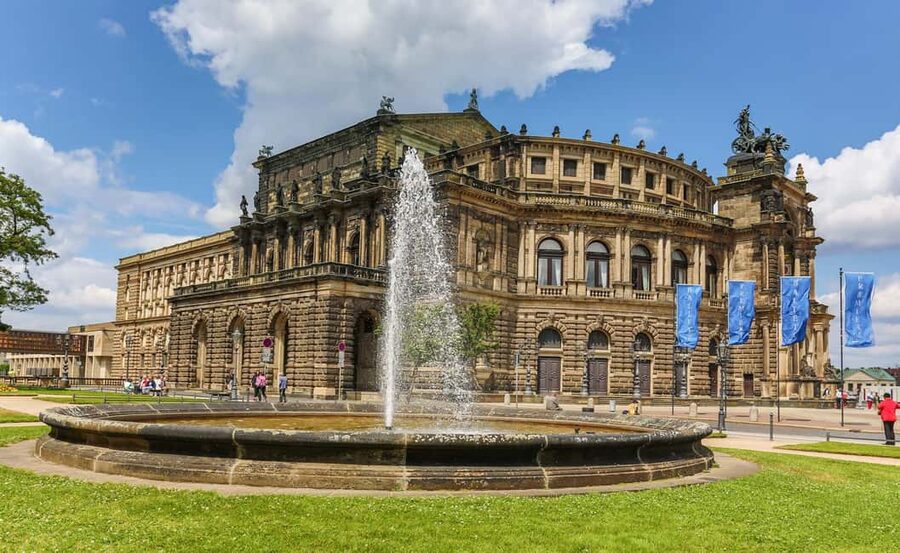
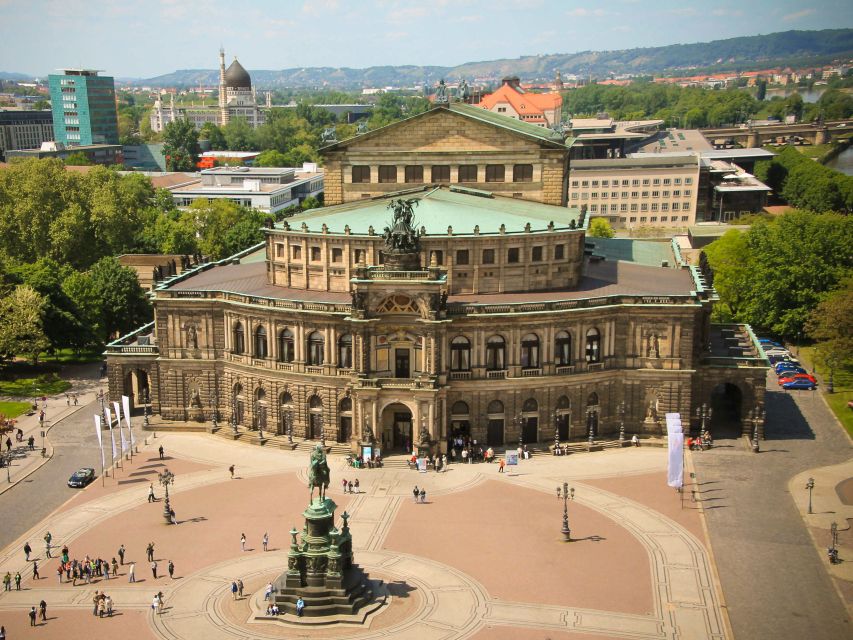
The Semperoper is one of Dresden’s signature buildings and a major stop on the route. Its ornate exterior fits the city’s Baroque mood, while its role as an opera house adds a cultural layer beyond palace and church architecture.
Your guide explains how the building fits into Dresden’s development and points out why it matters to the city’s identity. You should not expect an interior visit or a performance. This is an exterior-focused walking tour, so the value comes from the explanation and the view rather than from entering the opera house.
The Semperoper also shows how Dresden’s grand appearance was shaped by royal patronage and artistic ambition. Seen alongside the Zwinger and Dresden Castle, it helps form a picture of a city that was designed to impress.
If you want detailed information about opera history, architecture, or the interior, you will need a separate visit. For a first orientation, the stop gives you the essential context without adding tickets or a long queue.
A few more coffee tours around the world worth a look
- Istanbul Highlights: Guided Tour with Turkish Tea or Coffee
★ 5.0 · 278 reviews - Cagliari: 2-Hour Guided E-Bike Tour with Coffee
★ 4.7 · 240 reviews - Guided Tour to the only coffee farm in Europe
★ 5.0 · 174 reviews - Vienna: Guided Viennese Coffee-House Tour
★ 4.8 · 48 reviews
Zwinger: Baroque display at its boldest
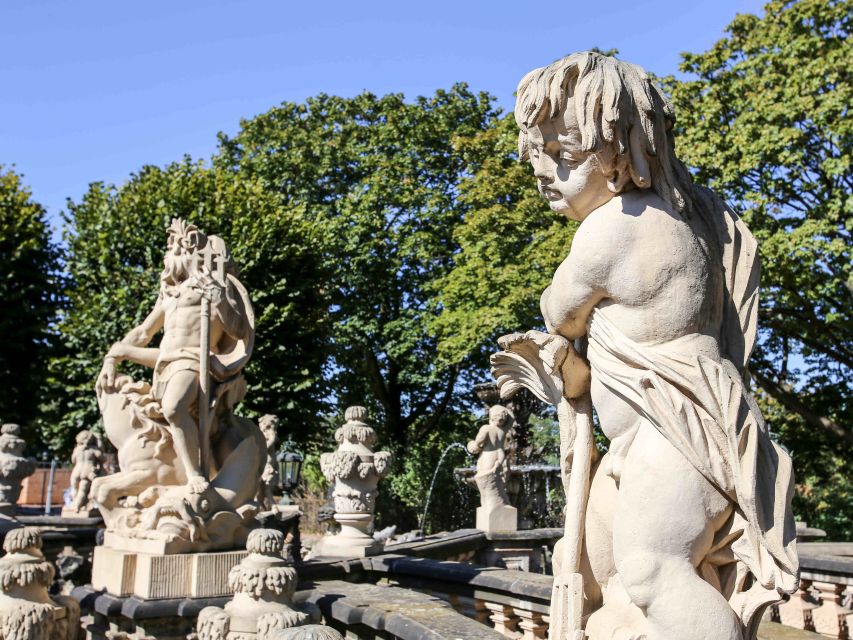
The Zwinger is the tour’s great Baroque set piece. Its elaborate pavilions, sculpted decoration, courtyards, and formal design show how Dresden’s rulers used architecture to project wealth and authority.
This is where the walk’s theme of Baroque power becomes easiest to see. The Zwinger is not modest, and it was never meant to be. The scale and ornament tell you something about the ambitions of the court that commissioned it.
A guide adds value here by explaining the building’s place in Dresden’s growth rather than simply pointing out its most decorative elements. You learn how the city developed around royal projects and how the Baroque style changed Dresden’s public face.
The limitation is time. The Zwinger deserves a longer visit if you want to explore its museums or courtyards at your own pace. Use the walking tour as an introduction, then return later if the architecture or collections catch your interest.
Dresden Castle and the Residenzschloss
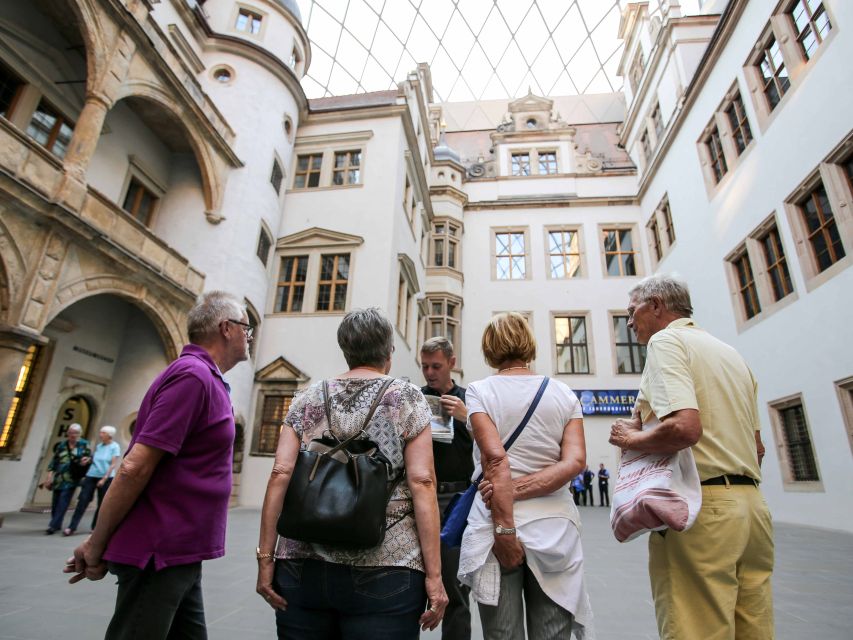
Dresden Castle, also called the Residenzschloss, brings the route back to the heart of royal power. The complex is tied closely to the rulers of Saxony and helps connect the other monuments you have already seen.
The castle is useful as a historical anchor. The Stallhof shows one part of court life, the Fürstenzug presents the ruling line, and the castle provides the central residence around which much of that power revolved. A guide can make those connections quickly, saving you from treating the sights as unrelated buildings.
The castle area also reflects Dresden’s complicated past. The tour moves beyond medieval and Baroque themes to discuss the destruction and later rebuilding of the city. That context is important because Dresden’s old town can look deceptively complete. The polished streets and grand facades do not tell the whole story by themselves.
The walk does not include admission to the castle’s museums. If you want the collections inside, plan separate time and budget. This tour is about seeing the castle in its urban setting and understanding its role.
From 1989 to modern Dresden
One of the more valuable parts of this experience is its attention to the Peaceful Revolution of 1989 and the experience of people in former East and West Germany. That subject keeps the tour from becoming a purely royal architecture lesson.
You hear about the feelings and pressures surrounding a divided Germany, then the changes that followed. This gives Dresden a modern political context that you will not get from looking at Baroque buildings alone.
The route also addresses newer and controversial buildings. That is a useful choice. Dresden is not frozen in the eighteenth century, and arguments about how to rebuild or modernize historic areas are part of the city’s present identity.
You should expect a broad introduction rather than a long political seminar. The 90-minute schedule leaves room for several centuries, so the guide must keep each period moving. Still, the inclusion of 1989 makes the walk more balanced and more honest than a tour focused only on royal splendor.
Taschenbergpalais, Augustus Bridge, and Dresden Cathedral
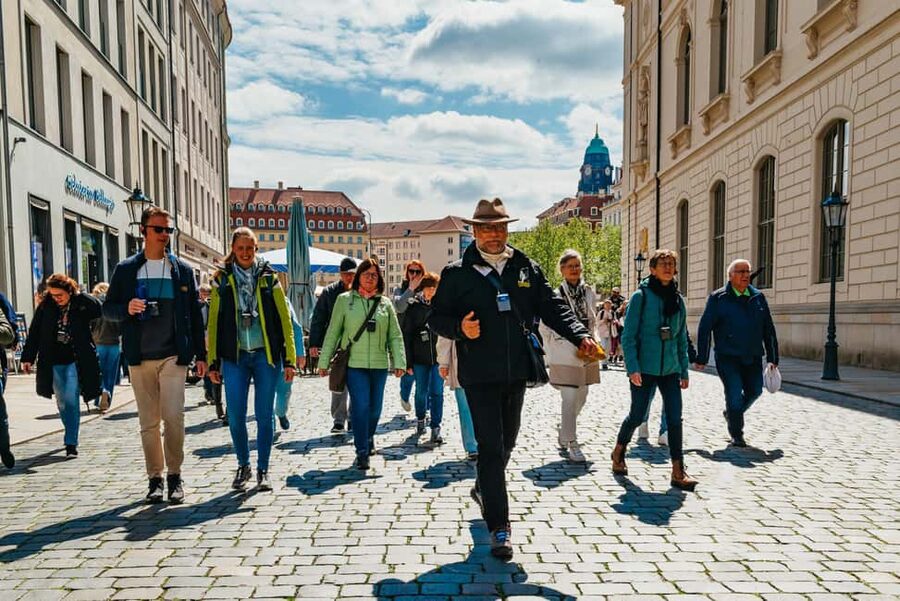
After Dresden Castle, the route continues toward Taschenbergpalais and Augustus Bridge before returning toward the Frauenkirche. These stops help fill in the spaces between the headline attractions.
Taschenbergpalais adds another reminder of courtly Dresden. It fits the route’s focus on the relationship between royal buildings, public spaces, and the city’s changing design.
Augustus Bridge gives you a transition between the old town and the Elbe setting. It helps you understand Dresden’s position along the river rather than seeing the historic center as a collection of inward-looking squares.
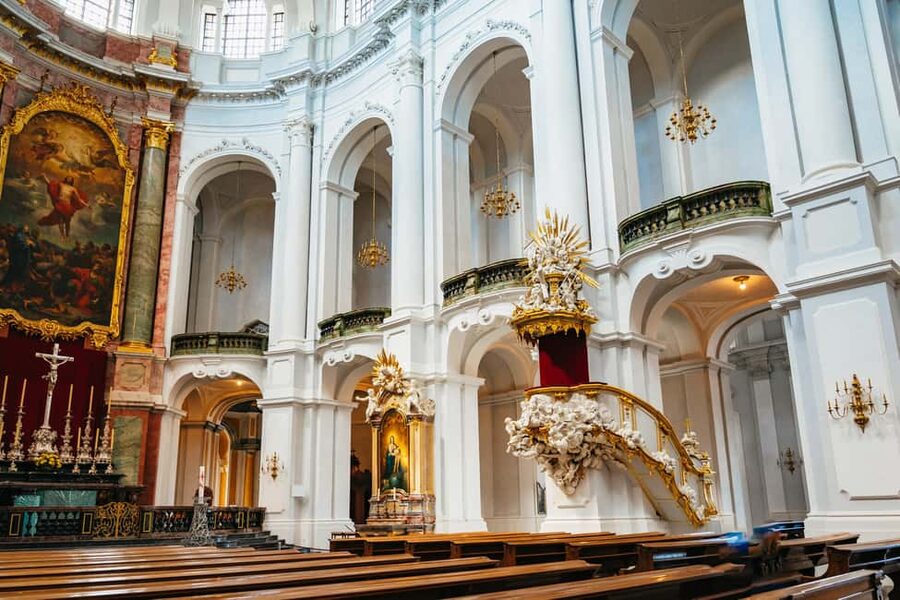
Dresden Cathedral provides another important religious landmark. Seen with the Frauenkirche, it lets you compare two major expressions of faith and power within the old town. The guide’s job here is to show how religious buildings fit into Dresden’s political and architectural story.
The exact amount of time at each stop depends on the guide and group pace. Since the experience ends near An der Frauenkirche, you should plan to keep personal sightseeing for afterward rather than expecting long free periods during the walk.
The coffee coupon and practical value
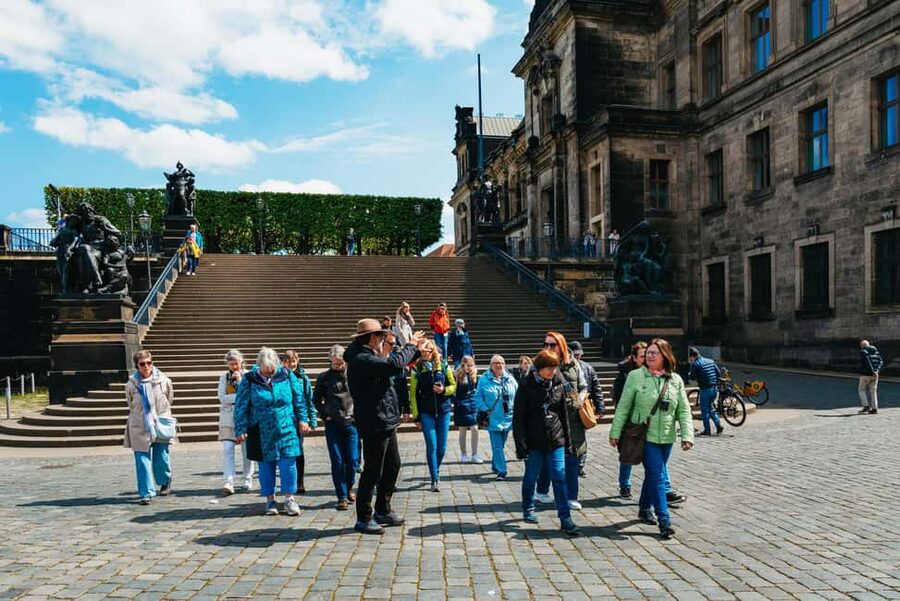
A free coffee coupon is included, which is a pleasant extra after a brisk city walk. The supplied information does not specify the café, drink choice, or redemption terms, so confirm those details with the guide before leaving.
One person reported that the coffee voucher was not handed out. That does not change the main value of the tour, but it is a practical point worth watching. If the coupon matters to you, ask for it directly at the end rather than assuming it will appear automatically.
The $15 price remains reasonable even without treating the coffee as the main attraction. You receive a live German-speaking guide, a structured route through the center, a digital audio system, and historical explanation at several major sights. The price is especially fair for visitors who want a guided introduction but do not need museum entry or a full-day program.
The audio system deserves attention, too. It should make the guide easier to hear than a standard group gathered around one speaker. That is useful in open squares and around busy monuments, though it does not remove the need to stay with the group.
Who should book this Dresden walk?
I would choose this tour if you are visiting Dresden for the first time, have limited time, or want a clear introduction before exploring on your own. It suits adults who enjoy architecture, city history, and political context, as well as families who want a short route rather than a long museum visit.
It is also a good fit if you want restaurant and leisure suggestions from someone working in the city. Those tips can help shape the rest of your day, particularly after the tour ends back around the Frauenkirche.
The biggest filter is language. The live tour is in German only. If you do not understand German, this is not the right choice, even though the sights themselves are easy to admire.
You should also know what the tour does not provide. There is no listed museum admission, no detailed interior tour of the Semperoper or Dresden Castle, and no guarantee of extended time at each monument. Think of it as a well-priced orientation walk, not a complete Dresden sightseeing day.
Should you book it?
Book this walk if you want Dresden’s main old-town sights tied together by a coherent story. The mix of Baroque architecture, royal history, twentieth-century change, and local advice gives you more than a simple photo route.
Skip it if you need an English-language tour, prefer extensive free time at each stop, or already know the old town well. For German-speaking visitors who want a compact start to Dresden, the $15 price, 90-minute length, audio system, and central route make this a sensible first step.
FAQ
Where does the Dresden walking tour begin?
Meet the guide in front of Dresden Information in the basement of the QF Passage.
Where does the tour finish?
The walk finishes near Frauenkirche at An der Frauenkirche, 01067 Dresden.
How long does the walking tour last?
The tour lasts 1.5 hours, or 90 minutes.
What language is the tour offered in?
The live guided tour is available in German only.
Which Dresden sights are included?
The route includes the Frauenkirche area, Stallhof, Fürstenzug, Brühl’s Terrace, Semperoper, Zwinger, Dresden Castle, Residenzschloss, Taschenbergpalais, Augustus Bridge, and Dresden Cathedral.
Is coffee included?
Yes. The booking includes a free coffee coupon. The café and redemption details are not specified, so ask the guide for the voucher and instructions.
Is the tour wheelchair accessible?
Yes, the activity is listed as wheelchair accessible.
Does the tour include museum or building admission?
No museum or interior admission is listed. The experience is a guided walking tour past Dresden’s main sights.
Can I cancel the booking?
Yes. You can cancel up to 24 hours in advance for a full refund. A reserve now and pay later option is also available.
Just added around the world
- Yerevan: Private Coffee Tour with 2 Café Stops★ 5.0 · 2 reviews
- Vietnamese Coffee 101 Workshop★ 5.0 · 11 reviews
- Vietnamese Coffee Making Class in Hoi An★ 5.0 · 4 reviews
- Vietnamese cooking class and coffee making with local girl★ 5.0 · 5 reviews
- Venice Delights: Coffee & Food Experience Walking Tour★ 5.0 · 2 reviews
- Private Vienna Tour: Literature Walk with Coffee House Visit★ 5.0 · 2 reviews
- Turin: Art Nouveau Walking Tour with Coffee★ 5.0 · 11 reviews
- Turkish Coffee and Traditional Turkish Dessert Cooking★ 4.6 · 8 reviews
Walking Tours, compared.


Hungry in Vienna? A Food Lover’s Coffee & Market Walk
Read our review →
Private Walking Tour, Food Tasting and Bosnian Coffee in Sarajevo
Read our review →
Hanoi Michelin Star Walking Food Tour & Train Street
Read our review →

Vienna Eats: Private Foodie Walk with Coffee & Markets
Read our review →
Angra do Heroísmo: Walking Tour with Local Pastry and Coffee
Read our review →
New Orleans True Crime and Coffee Walking Tour: Adults Only
Read our review →Browse the lists this tour appears in